
It’s been a very exciting few months for procurement nerds like me. First, in mid-July we had the leaked draft of the new EU Public Procurement Regulation, copies of which were squinted over on beaches between the Black Sea and the Blasket Islands. Then on 9 September the Commission’s proposal was formally published, with a number of significant changes compared to the leaked draft. Whether any of these reflected the critical commentary on the draft, or were based solely on quiet conversations amongst those not at the beach, is unknown. In any event we now have an official proposal to discuss, and my feeds are full of infographics and opinions. For fear of being left out, here are my initial thoughts (and a spider diagram!)
- Transparency is the big winner, if the systems work
The proposal sets out requirements for public buyers to publish ‘summaries’ at a minimum of four points in the procurement cycle: i) competition ii) result iii) public summary of contract and iv) upon completion or termination of the contract. If market consultation is undertaken or modifications made after award, additional public summaries must be issued. These will be published via the national and EU Public Procurement Data Spaces, with substantial new digital infrastructure to be put in place. The first thing to note is that the public summary of contract and of completion/termination are new, and although their precise content is not yet clear, they potentially represent a significant increase in the transparency associated with many public contracts.
Even more significant is the obligation to publish certain details on below-threshold contracts valued above €10,000 (Article 134) and to publish details of payments made under contracts (Article 108). The potential for genuine transparency gains is real; the administrative and technical challenges in making high-quality data available are equally real. Many public bodies struggle to publish accurate and complete notices under the current regime, so resourcing, incentives and training will be key to making it work – alongside intuitive digital systems.
Interestingly the term ‘procurement documents’ has disappeared, as has the concept of a ‘notice’. Two new terms ‘procurement detail’ and ‘procurement information’ are defined in the draft, with Recital 52 indicating that a European standard will be developed for procurement details. Article 97 indicates that the procurement detail (which includes specifications) must be made available from the start of the competition until three years after the award of the contract. While Article 93.3 provides for certain exceptions based on security reasons, there appears to be no ability for public buyers to withhold details based on commercial confidentiality considerations. On the other hand, economic operators are given confidentiality protection for sensitive aspects of tenders under Article 93.1.
2. Qualitative award criteria are hot, selection criteria are not
The use of qualitative award criteria remains very uneven across Europe. Many see this as impeding sustainability and long-term value in public procurement, and will welcome the proposed minimum weightings for qualitative award criteria. Article 98 sets this at 30%, rising to 50% for labour-intensive services – however two workarounds are available. The first is by including relevant quality considerations in the specification, contract performance conditions or some combination of these and the award criteria. For example, if the specification requires a warranty, this might justify a lower (or even no) weighting for quality at award stage.
The second is through application of life-cycle costing – which may have no connection to either quality or sustainability. For example, a simple approach to life-cycle costing may just take purchase price and annual maintenance costs into account. Article 98.4 states that where LCC is applied “the weight given to life-cycle costs shall be counted within the respective percentage share” to meet the minimum qualitative weighting. As costs, including life-cycle costs, should always be evaluated as a single weighted criterion,[1] this suggests that the weighting assigned to purchase price will also count towards the minimum quality percentage – which is nonsensical.
Overall, if the rules on qualitative award criteria remain in their current form, their impact may be limited. In a previous article I discussed the risks associated with taking a formulaic approach to quality criteria, the fear factor which often means quality marks are clustered closely together (undermining any minimum weighting) and how the use of AI both in tender preparation and evaluation needs to be carefully considered. The proposal is notably silent on use of AI, raising the possibility that some public buyers will outsource qualitative evaluations to machines. At a minimum, this requires consideration of how the rules on conflicts of interest set out in Article 94, which currently refer only to ‘persons’ should apply to AI, which has interests of its own.
The selection of bidders has clearly been identified as a restriction on competition. The proposal aims to reduce the use of selection criteria, although it does include an option to select bidders under the dynamic procedure, as well as preservation of qualification lists for utilities (both absent from the leaked draft). Restrictions on the content of selection criteria, such as a ban on requiring prior public sector experience and a significant reduction in the level of turnover which bidders can be required to demonstrate, remain.
These may help smaller or newer market entrants to bid for public contracts, although in my view the reasons for declining competition for public contracts are primarily structural (contract size, perception and reality of incumbent advantage, concentration in markets) rather than procedural in nature. On the question of incumbent advantage, the new restrictions on public buyers acquiring intellectual property rights (Article 64) may exacerbate this, especially in IT-related contracts. While Article 64 does allow IP transfer in some cases, this is restricted, in particular under the Innovation procedure. If a public buyer cannot acquire IP in appropriate cases, this can increase incumbent advantage and make it difficult to retender a contract fairly.
3. Negotiation is the new norm
All three of the procedures available to public buyers (Open, Dynamic and Innovation) now include the possibility to negotiate with bidders in one or more rounds. For the Open procedure, if negotiation is chosen there is a requirement to invite all interested operators who comply with the exclusion and selection criteria to negotiate, based on their first tenders. Buyers can still choose not to negotiate with anyone, even if they have indicated that they plan to in the contract summary (this option, which can help to avoid bidders inflating first round prices, was missing from the leaked draft). What they can’t do is choose only to negotiate with a limited number, based on the first tenders. Negotiations can be time consuming and generally require experienced staff to be available, so many buyers will struggle to negotiate if a large number of tenders are received.
Article 33 defines the rules for negotiation which apply across all procedures. Art 33.1 requires that ‘in any given round of negotiations the number of solutions discussed allows for genuine competition’ – suggesting that negotiation with the designated successful bidder at the end of a process (a feature, for example, of the current competitive dialogue procedure) is not allowed. Article 33.2 provides that:
“public buyers may negotiate all non-essential characteristics of the works, supplies and services intended for purchase, which may include certain elements related, for instance to technical merit, quantity, delivery conditions and other commercial aspects, but does not include exclusion grounds, selection criteria and award criteria.”
Interestingly there is no explicit reference to negotiating on price or cost, although this could potentially be included under ‘other commercial aspects.’ There is a need to clarify this, as price negotiations are a key part of many current procedures, particularly for the utilities sector.
4. European preference looks like a paper tiger
While preferences for European goods and services formed an important part of the political ambition for the reform, the rules set out in the proposal seem unlikely to have a major impact. Under Article 73, public buyers may restrict access or apply a scoring preference for ‘covered economic operators’ – which includes all those with access under the GPA or trade agreements. As this is left up to the discretion of the individual buyer, and the vast majority of tenders received are from EU/EEA/GPA operators, it seems unlikely that it will result in a noticeable decrease in public procurement spend with third-country operators. While the EU content rules potentially reach deeper into supply chains, affecting for example supplies or materials coming from China or other countries, these are again optional for public buyers to apply, and given their complexity many may opt not to. Of greater potential impact are restrictions adopted at EU level, under existing instruments such as the International Procurement Instrument, the proposed Industrial Accelerator Act, or under the new powers delegated to the Commission by Articles 72 and 77.
The proposal goes to great lengths to reassure the EU’s trade partners that their companies will not face discrimination. The application of the equal treatment principle to ‘covered economic operators’ from these countries is written into the Article 4 Principles, and when it comes to exclusion, non-EU companies may even have an advantage, as Article 25 on Mandatory exclusion refers only to convictions in a Member State. Does this mean convictions in the US, UK or elsewhere for fraud or corruption (for example) are no longer relevant? This may just be a drafting error. Similarly, the optional exclusion under Article 26.1(a) refers only to breaches of applicable obligations under EU law, meaning that it would no longer be possible to exclude a bidder based on breaches of national minimum wage legislation or binding collective agreements, as is the case under the 2014 Directives.
5. Incoherence remains on sustainability, remedies and AI
The Regulation aims to increase the coherence of EU public procurement law by incorporating much of the sectoral legislation adopted in recent years which creates obligations on public buyers and/or businesses. For example, Article 52 replicates some, but not all, of Article 7 of the Energy-efficiency Directive. Article 54 remains rather confused and contradictory in my reading – is it setting a ceiling for sustainability criteria or only a floor? The (non-exhaustive) lists of environmental, social and innovative considerations which may be taken into account may be welcome in that they solidify the legal basis for including these in specifications, selection and award criteria and contract performance clauses. They do not go any further than existing CJEU case law or Commission guidance. And there are no new mandatory SPP provisions, unless you count the (not actually mandatory) minimum quality weighting. Unfortunately, to me the sustainability provisions seem more like optics than anything that will shift the dial on the breadth or depth of sustainable procurement across the EU.
Here is my spider diagram assessing how the proposal scores against the various objectives of the reform:
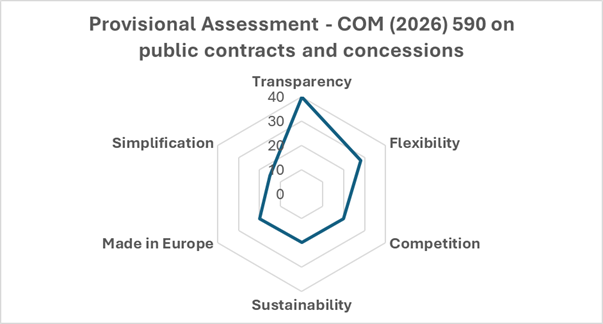
Transparency and flexibility are definitely increased, although there are also new restrictions on flexibilities currently available to public buyers in areas such as IPR, and especially to utilities in relation to frameworks, aggregation and negotiations. As drafted, the proposal seems unlikely to move the dial much on sustainability, competition or the value of procurement spend which remains within Europe. In terms of competition, while increased transparency will generate some gains, the restrictions on selection criteria may not address the underlying reasons why many firms don’t bid for public contracts. And then there’s simplification: the elusive holy grail of procurement reform. If we think of the simplest possible way to award a contract, award based on price alone comes to mind. There are obvious reasons why we have moved beyond this, and there is inevitably a trade-off between simplicity and flexibility.
Finally, there are a couple of significant missed opportunities to note. Revision of the ancient and creaking remedies rules seems to have been passed over, surely a major missing piece in any coherence project. Having to refer back to a much-amended 1989 Directive is hardly ideal. And while the Commission feels comfortable with selection of bidders by random indiscriminate algorithm, it has maintained silence on the use of AI in both the preparation and evaluation of tenders, which seems certain to pose legal and ethical challenges in the near future. Plenty for the Council and Parliament, as well as us interested bystanders, to focus on during the trilogues.
[1] Otherwise, if say 30% is given to purchase price and 10% to maintenance (or other costs), bidders are able to manipulate the cost scoring by simply ‘loading’ their costs into the lower-weighted component.
Leave a Reply